
Identifying Your Hot Water System Type
Before you can troubleshoot, you need to know what type of hot water system you have. Brisbane homes typically have one of four types. Electric storage systems are the most common — a large tank (usually 125 to 315 litres) sitting outside, often on a concrete pad near the laundry. Gas storage systems look similar but have a gas line running to them and a small pilot light window near the bottom. Gas continuous-flow (instantaneous) systems are wall-mounted units about the size of a briefcase, usually on an exterior wall. Solar hot water systems have panels on the roof with a storage tank either on the roof or at ground level, often with an electric or gas booster. Heat pump systems look like a split system AC outdoor unit connected to a storage tank. Knowing your system type determines which troubleshooting steps to follow.
- •Electric storage: large tank, connected to power, no gas line
- •Gas storage: large tank with gas line and pilot light window
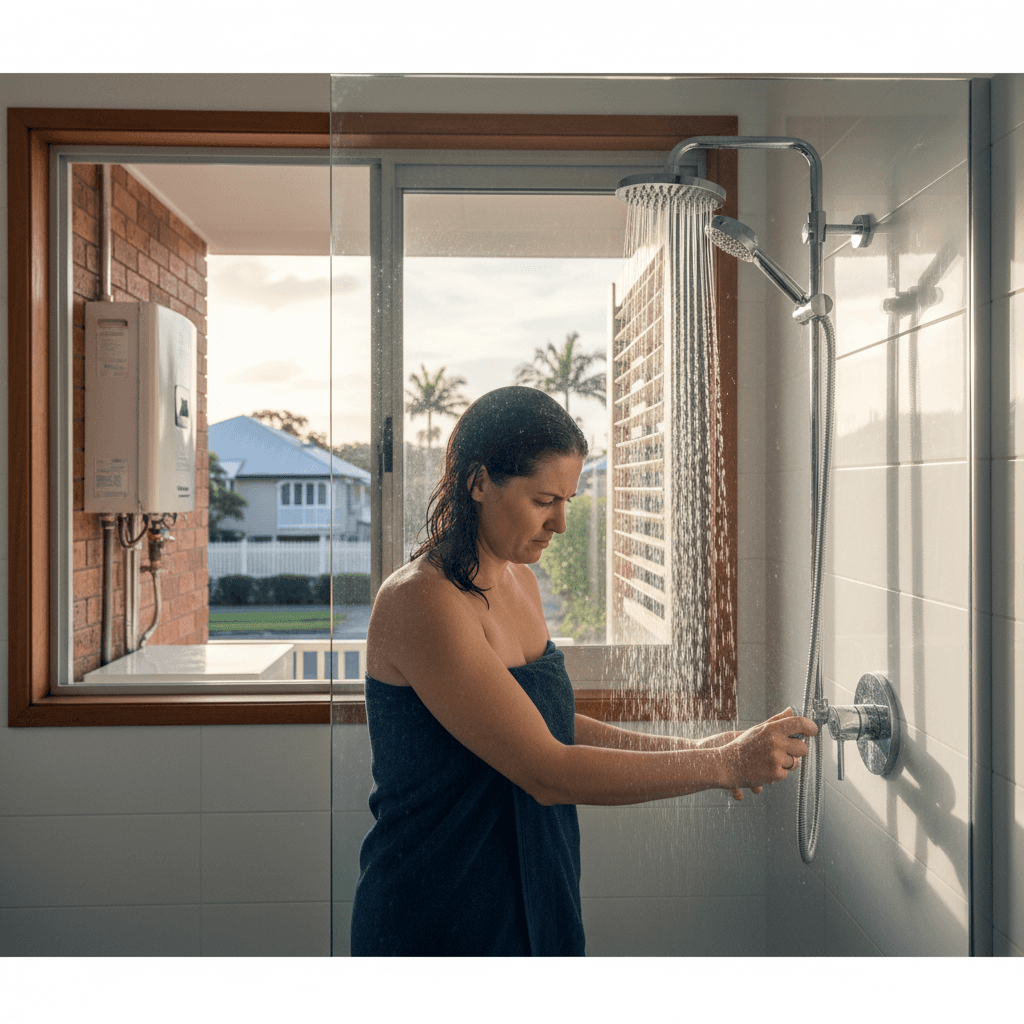
- •Gas continuous-flow: small wall-mounted unit with gas line
- •Solar: roof panels with storage tank and electric/gas booster
- •Heat pump: unit resembling AC outdoor unit with storage tank
Troubleshooting Electric Hot Water Systems
If you have an electric storage system and no hot water, start at your switchboard. Look for a circuit breaker labelled 'hot water' or 'HWS' — if it has tripped, reset it by switching it off then on. Many Brisbane electric hot water systems run on a controlled load tariff (Tariff 33 or Economy), meaning Energex controls when they heat — typically overnight. If your hot water ran out during the day, it may simply need to wait until the overnight heating cycle. Check if your system has a 'boost' button that activates daytime heating. Also check the unit itself for visible leaks, rust stains, or water pooling around the base — these indicate the tank has failed internally and needs replacement. A failed tempering valve can also cause no hot water at the taps even though the tank is hot — the valve mixes cold water in to prevent scalding and can fail in the 'all cold' position.
- •Check switchboard for tripped 'hot water' circuit breaker
- •Controlled load tariff: system may only heat overnight
- •Look for a 'boost' button for daytime heating
- •Check for leaks, rust, or water pooling around the tank
- •A failed tempering valve can block hot water delivery
Troubleshooting Gas Hot Water Systems
For gas storage systems, the most common cause of no hot water is an extinguished pilot light. The pilot light is a small flame visible through a window near the base of the tank. If it is out, follow the relighting instructions on the label of your unit — typically you turn the gas control knob to 'pilot', press and hold it while pressing the ignition button, then continue holding for 30 seconds after the pilot lights before turning to 'on'. If the pilot will not stay lit, the thermocouple (a safety sensor) may have failed — this is a straightforward repair for a plumber. For continuous-flow gas systems, check that the gas supply is on and that the unit has power (most need electricity for the electronic ignition). An error code on the display panel will help the plumber diagnose the issue faster — note it down before you call.
- •Gas storage: check if the pilot light is out and relight it
- •Follow the relighting instructions on the unit label
- •If pilot will not stay lit, the thermocouple may need replacing
- •Continuous-flow: check gas supply and power to the unit
- •Note any error codes on continuous-flow display panels
When to Call an Emergency Plumber
Call a plumber if: the pilot light will not relight or stay lit, the circuit breaker keeps tripping for the hot water system, you see a significant leak or pooling water around the tank, the tank is making unusual banging or hissing noises, or you smell gas near the unit (if you smell gas strongly, evacuate and call your gas provider's emergency line or 000 first). In Brisbane, a plumber can typically diagnose and repair common hot water issues for $150 to $400. If the system has failed completely and needs replacement, expect $1,000 to $1,800 for a basic electric storage replacement, $1,500 to $3,000 for a gas continuous-flow installation, or $2,500 to $4,500 for a heat pump system. Most plumbers can do same-day replacement for standard electric and gas systems if they have stock.
- •Pilot light will not stay lit after relighting
- •Hot water circuit breaker keeps tripping
- •Significant leak or water pooling around tank
- •Unusual banging or hissing noises from tank
- •Gas smell near unit (evacuate first, call gas provider)
- •Electric storage replacement: $1,000–$1,800
- •Gas continuous-flow: $1,500–$3,000
- •Heat pump system: $2,500–$4,500
Hot Water System Lifespan and Planning Ahead
Most hot water systems in Brisbane last 8 to 12 years for storage systems and 15 to 20 years for continuous-flow gas. If your system is approaching these ages, a failure is not a matter of if but when. Rather than waiting for an emergency replacement — which limits your options and may cost more due to urgency — consider planning a replacement during a quieter time. This gives you time to compare quotes, choose the most efficient system for your household, and potentially access government rebates for heat pump or solar systems. The Queensland Government and some local councils offer rebates of $300 to $1,000 for switching from electric storage to heat pump or solar hot water, which can significantly offset the higher upfront cost.
- •Storage systems: 8–12 year typical lifespan
- •Continuous-flow gas: 15–20 year typical lifespan
- •Plan replacement before emergency failure if system is ageing
- •Government rebates available for heat pump and solar systems
- •QLD rebates: $300–$1,000 for switching from electric storage