
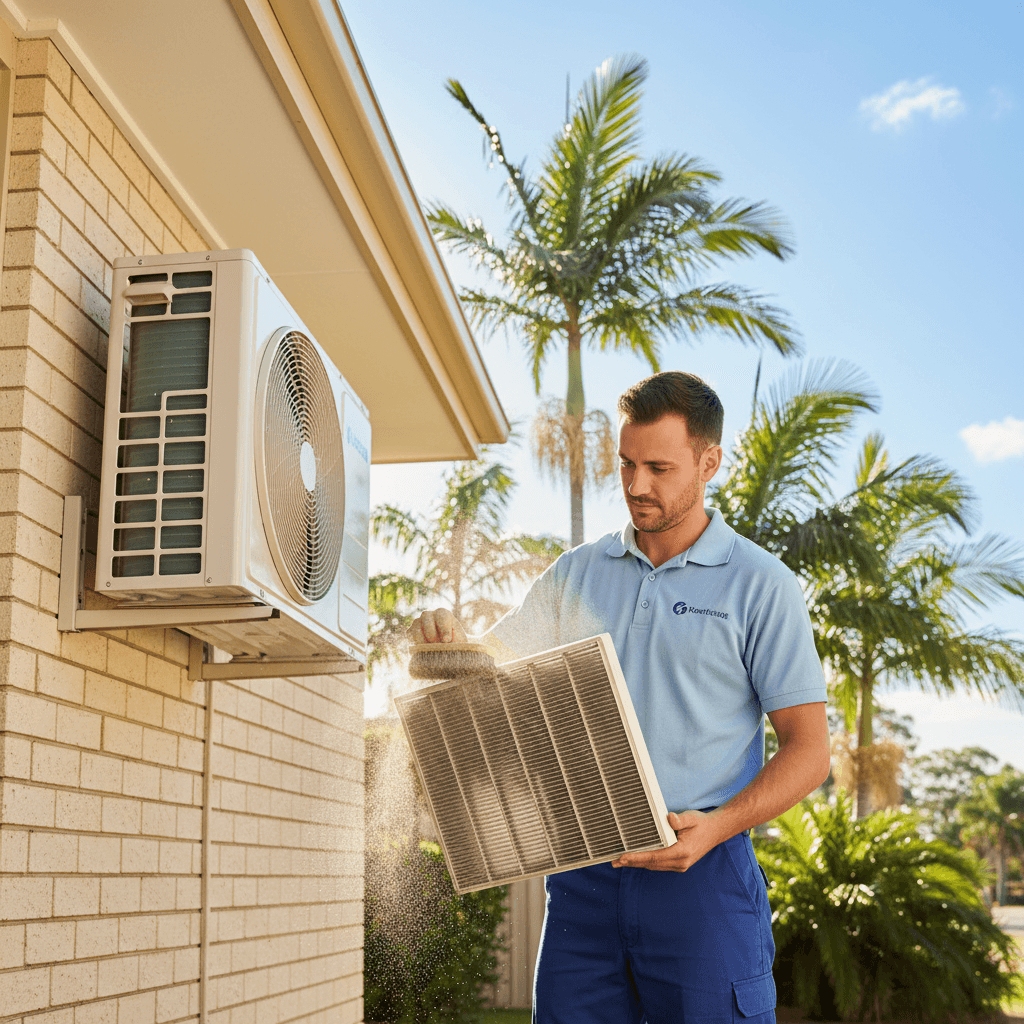
When to Book Your Pre-Season AC Service
The best time to service your air conditioner in Brisbane is September to early October — before the heat sets in but late enough that any issues found can be repaired before you need the system. HVAC technicians are less busy during this period, so you will find it easier to book an appointment and may get better pricing. By mid-November, demand for AC services skyrockets and emergency callout fees apply as technicians are stretched thin. A standard pre-season service costs $120 to $250 for a split system and $200 to $400 for a ducted system, and takes about an hour.
- •Book your service in September or early October
- •HVAC techs are less busy and more available pre-season
- •Split system service: $120–$250
- •Ducted system service: $200–$400
- •Avoid the November–December rush when emergency rates apply
DIY Maintenance You Can Do Yourself
Before calling a technician, there are several maintenance tasks you can do yourself at no cost. Clean the air filters on your indoor unit every 2 to 4 weeks during summer — this alone prevents the majority of performance issues. Clear leaves, grass clippings, and debris from around the outdoor unit, maintaining at least 30 cm of clearance on all sides. Wipe down the indoor unit's exterior and check that air vents are not blocked by furniture or curtains. Test the unit by running it for 30 minutes in cooling mode and check that cold air is coming out — if it is blowing warm, a professional service is needed.
- •Clean indoor unit filters every 2–4 weeks in summer
- •Clear debris from around the outdoor unit (30 cm clearance)
- •Wipe down the indoor unit exterior
- •Ensure air vents are not blocked by furniture or curtains
- •Run a 30-minute test in cooling mode before summer
What a Professional AC Service Includes
A professional pre-season service goes well beyond filter cleaning. The technician will check refrigerant levels and pressure (low refrigerant indicates a leak), inspect and clean the evaporator and condenser coils, check the compressor operation and electrical connections, test the thermostat accuracy, inspect the condensate drain for blockages, check the fan motor and bearings, and test the overall system performance and energy efficiency. For ducted systems, they will also inspect the ductwork for leaks, check zone dampers and controllers, and assess the condition of duct insulation. A good technician will provide a written report on the system's condition and flag any issues before they become emergencies.
- •Check refrigerant levels and pressure
- •Clean evaporator and condenser coils
- •Inspect compressor and electrical connections
- •Test thermostat accuracy and calibration
- •Clear the condensate drain line
- •For ducted: inspect ductwork, dampers, and insulation
Warning Signs Your AC Needs Urgent Attention
Do not wait for a total breakdown. Book a service promptly if you notice any of these warning signs: the unit is blowing warm or lukewarm air instead of cold, cooling performance has noticeably dropped from previous summers, the unit makes unusual noises (rattling, grinding, or squealing), there is a musty or chemical smell when the unit runs, the indoor unit is leaking water, ice is forming on the indoor unit or refrigerant lines, or your electricity bills have spiked without a change in usage. Addressing these issues early during a standard service call is far cheaper than an emergency breakdown in the middle of January.
- •Warm or lukewarm air instead of cold
- •Noticeable drop in cooling performance
- •Unusual noises: rattling, grinding, squealing
- •Musty or chemical smell from the unit
- •Water leaking from the indoor unit
- •Ice forming on the indoor unit or lines
- •Unexplained spike in electricity bills